


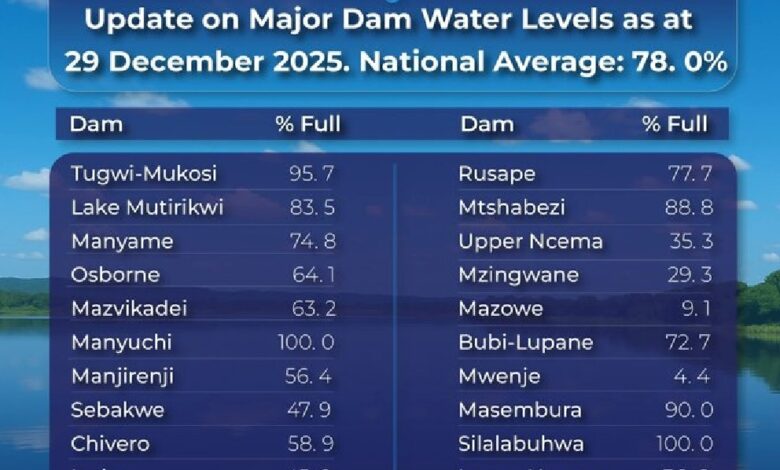
Zimbabwe’s major dams have swelled to an average of 78 percent capacity following weeks of sustained rainfall across the country’s catchment areas, the Zimbabwe National Water Authority (ZINWA) reported Sunday, prompting urgent warnings for downstream communities to prepare for possible flooding.
The dramatic recovery marks a significant turnaround for a nation that has grappled with water scarcity in recent years, though authorities caution that rising levels now present new risks as several dams approach or exceed their safe operating limits.
Three dams—Manyuchi, Zhovhe, and Silalabuhwa—have reached full capacity, while the massive Tugwi-Mukosi reservoir stands at 95.7 percent, just 4.3 percentage points from overflowing. Lake Mutirikwi, a key water source for Masvingo province, has climbed to 83.5 percent.
“Communities downstream are urged to remain alert,” ZINWA stated in its December 29 update, emphasizing the potential danger as inflows continue and spillage becomes increasingly likely.
Masembura dam in Mashonaland West has risen to 90 percent, while Mtshabezi, serving Bulawayo’s water needs, stands at 88.8 percent—levels that offer relief for urban water supply but require careful monitoring.
The situation in Harare presents a more complicated picture. While Manyame dam has recovered to 74.8 percent and Chivero—the capital’s primary water source—sits at 58.9 percent, Harava reservoir remains critically depleted at just 19.6 percent, highlighting the uneven distribution of recent rainfall.
Despite the national average, Zimbabwe’s southwestern region continues to struggle with chronic water stress. Upper Ncema (35.3%) and Lower Ncema (36.6%) remain well below optimal levels, while Inyankuni dam sits at a perilous 10.9 percent—barely enough to sustain local communities through the remainder of the season.
Upper Insiza (26.7%) and Mzingwane (29.3%) similarly reflect the region’s vulnerability, though Bubi-Lupane offers a bright spot at 72.7 percent. The disparities underscore long-standing concerns about water infrastructure equity and climate variability across Zimbabwe’s provinces.
Agricultural and Economic Implications
The robust dam levels arrive as a lifeline for Zimbabwe’s agriculture-dependent economy, promising improved irrigation prospects for the current farming season and enhanced hydroelectric power generation at facilities like Kariba Dam. However, water management experts warn that the benefits come with responsibilities.
Other notable levels include Rusape at 77.7 percent, Mazvikadei at 63.2 percent, and Osborne at 64.1 percent. Several smaller dams remain concerning: Mazowe sits at just 9.1 percent and Mwenje at 4.4 percent, suggesting localized drought conditions persist despite national improvements.
ZINWA has urged residents in flood-prone areas near major dams to monitor water levels closely and heed any evacuation orders from local authorities. The authority maintains updated dam level information on its official website for public access.
The current water situation reflects the complex interplay of climate, infrastructure, and geography that defines Zimbabwe’s ongoing struggle to balance water security with flood risk management—a challenge that appears set to intensify as the rainy season progresses into early 2025.