

She Codes by Day and Writes by Night — Bulawayo Author Emmah Mpofu Refuses to Choose Just One


Valencia Ndhlovu
Emmah Zanele Mpofu wakes up to the same problem every morning: there is too much she wants to build. On any given day, that might mean working on a software application, analysing policy data for a research brief, or sitting quietly with the manuscript of her second book, a novel she is coaxing toward completion between everything else.
Most people choose one of these lives. Mpofu (29) has decided, without much fanfare, to live all three at once. She revealed this during Weekly Pulse, a Whatsapp group Engagement hosted by Matebeleland Pulse.
In a professional landscape that rewards specialisation and punishes distraction, the author, researcher and certified full-stack software developer has built something genuinely rare, a career that does not apologise for its own ambition. She is not a developer who dabbles in writing. She is not a writer who happens to understand technology. She is both, fully, and she has the published work to prove it.
Mpofu’s academic and professional life sits at a crossroads that few people think to occupy. Her work focuses on the intersection of technology, communication and social transformation, a space that sounds abstract until you understand what it actually demands. It requires a person to be comfortable with data and with doubt, with systems and with souls.
Within this space, she has developed a particular focus on sustainable development through the lens of the United Nations Sustainable Development Goals. Gender equity. Climate adaptation. Community resilience. These are not side interests, they are the questions that organise her professional life and, as it turns out, her creative one too.
For years, Mpofu operated within the language of research. She gathered statistics, analysed policies, mapped social structures. She was good at it. But something was missing, not from her work, exactly, but from the picture her work was painting.
“As a software developer and researcher, I spent a lot of time analysing social structures, policies and statistics,” she said, “but I began to realise that numbers alone do not fully capture the lived realities behind them.”
It is a simple observation. It is also a profound one. Data can tell you that a community is struggling. It cannot tell you what that struggle feels like at seven in the morning when someone is trying to get their children to school. Research can identify patterns of grief. It cannot sit with a person inside their grief and say: I see you. I have been here too.
Mpofu saw the gap. And instead of waiting for someone else to fill it, she picked up a pen. Conversations with Life — Mpofu’s debut book, available in hardcover and Kindle edition on Amazon, did not begin as a publishing project. It began as a reckoning.
“Life’s most important lessons often come quietly,” she said, “in everyday experiences, moments of stillness, loss or unexpected change.”
The book explores themes of healing, faith, grief, resilience and personal transformation. It invites readers into the kind of reflection that does not come with instructions, the slow, sometimes painful work of understanding who you are becoming and why the difficult seasons of your life are not wasted ones.
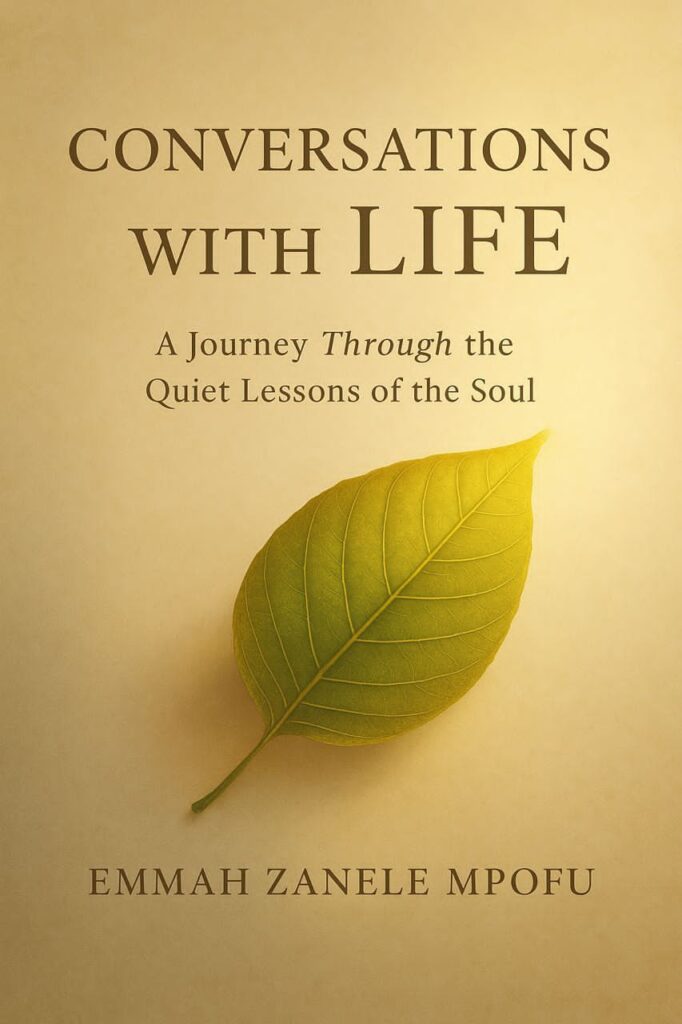
Mpofu says the book emerged from a deeply reflective period when she found herself sitting with questions she had previously been too busy to ask. Questions about growth. About pain. About what it means to be transformed by the very experiences you would have chosen to avoid.
“Writing the book was both a creative and personal journey,” she said. “It allowed me to explore questions about resilience and healing while reflecting on experiences that many people struggle to articulate.”
The book’s opening chapter captures this spirit in lines that stop you mid-sentence:
“Pain is not a punishment. It is a teacher. You cannot reach the light without first splitting the shell that kept you safe.”
It is the kind of writing that does not announce itself. It simply arrives, and then stays with you.
For all its intimacy, Conversations with Life was not an easy book to write, and not for the reasons most people assume. The challenge was not technical. Mpofu is a trained researcher. She knows how to organise ideas, construct arguments, sustain a line of thinking across pages. The challenge was something else entirely.
“It required vulnerability,” she said, “because I was confronting personal emotions and life lessons on the page.”
That is the part that the writing guides do not always prepare you for. You can learn structure. You can study craft. But sitting down to write honestly about the things that have broken you and then choosing to share that with strangers — requires a kind of courage that has nothing to do with skill. Mpofu found her way through it with discipline and purpose.
“I had to create a structured routine,” she said, “and remind myself that the goal was to create something that could help others reflect and heal.”
That shift from writing as self-expression to writing as service, is what many first-time authors discover somewhere in the middle of their manuscript. The book stops being about you. It becomes about the reader sitting alone at midnight, looking for proof that what they are feeling is survivable. Mpofu understood this. And she kept writing.
The practical reality of Mpofu’s life is one that many ambitious people will recognise immediately: there is never enough time, and the work does not stop multiplying.
Software development is not a nine-to-five. Neither is research. Neither is writing a book while also building a second one. Yet Mpofu has found a way to hold all of it — not by working harder than everyone else, necessarily, but by being more intentional about why each part of her work matters.
“For me, writing remains closely connected to my work as a researcher and social thinker,” she said. “It is another way of examining human experiences, questioning social realities and encouraging reflection about the choices we make as individuals and communities.”
This is the insight that makes Mpofu’s story more than a profile of an impressive person. It is a working model for what happens when you refuse to let your disciplines compete with each other and instead ask them to collaborate. Her research makes her a better writer — she sees patterns, context, systemic causes. Her writing makes her a better researcher — she stays close to the human cost of the statistics she studies. Her work in technology keeps both grounded in the practical question of how change actually gets built.
The three versions of Emmah Mpofu are not fighting for the same hours. They are feeding each other.
Beyond Conversations with Life, Mpofu is currently in the editing stage of her debut novel, Echoes of the Past. She has not said much about it yet, the work is still being shaped but the title alone suggests a writer moving deeper into narrative territory, into the longer, more complex form that demands everything a writer has learned and then asks for more.
In the meantime, she has something to say to the Zimbabweans who are carrying their own unwritten stories.
“You do not need a particular degree or career path to tell meaningful stories,” she said. “Zimbabwe is full of rich stories, histories and perspectives that deserve to be documented.”
It is a statement that carries weight coming from someone who built her career on technical precision. She is not romanticising the writing life or pretending the barriers do not exist. Publishing costs are real. Access is unequal. The industry, even in its digital form, is not designed with Zimbabwean writers in mind.
But Mpofu points to a practical door that is already open. Amazon’s Kindle Direct Publishing allows authors to bring their work to a global readership without paying upfront fees. No publisher required. No gatekeeping committee. No waiting years for someone in another country to decide that your story is worth telling.
Her advice is as uncluttered as her writing: begin with the resources available, and focus on sharing authentic stories.
Emmah Mpofu’s story is not really about career diversity, though it is that too. It is about what happens when someone trained to analyse human experience decides that analysis alone is not enough — that the full truth of a life requires both the data and the story, both the system and the soul.
Zimbabwe needs its researchers. It needs its software developers. It needs its policy analysts and its social scientists and its people who can read a spreadsheet and tell you what it means for a community of ten thousand people.
But it also needs its writers. It needs the people willing to sit inside the difficult experiences and bring back something true. It needs the voices that can take what the data cannot hold — the grief, the resilience, the quiet lessons of an ordinary Tuesday — and make it visible. Mpofu has decided to be both kinds of person. In doing so, she has made the argument, more convincingly than any essay could, that we do not have to choose.
Conversations with Life by Emmah Zanele Mpofu is available in hardcover and Kindle edition on Amazon. Her debut novel, Echoes of the Past, is currently in the editing stage.
Follow Matebeleland Pulse for more profiles of Zimbabweans building extraordinary lives.