
30 Girls Every Day: Inside Matabeleland North’s Teen Pregnancy Emergency

Rutendo Mapfumo
Sekani Nyathi is 18 years old, from Makwandara in Hwange, and raising a three-month-old daughter alone. She knew youth-friendly health services existed in her district. She simply could not get to them.
“I know about youth-friendly services, but I am afraid to go,” she says.
The nearest clinic was beyond walking distance. Transport cost money her family did not have. And in a small rural community, the stigma of being seen at a youth health facility was a barrier as real as any road. So she stayed home, gave birth without medical support, and became one of nearly 30 girls who fell pregnant every single day in Matabeleland North over the past two years.
Between January 2023 and March 2025, more than 21,000 teenagers fell pregnant across the province, according to the provincial health information system.
Sister Nomathemba Dube (Not her Real Name )has worked at Lukhosi Hospital Hwange Rural Hospital’s maternity ward for eleven years. She says the numbers in her ward tell the same story the provincial statistics do — but with faces attached.
“We are seeing girls here who are fourteen, fifteen years old. Some come alone because their mothers do not know. Some come too late because they were afraid. We do the best we can, but a hospital cannot fix a problem that begins thirty kilometres away in a household with no food and a daughter who has dropped out of school.
Minister of State for Provincial Affairs and Devolution Richard Moyo, who revealed the figures at a National Aids Council advocacy meeting in Lupane, did not soften the message. “These are not just statistics,” he said. “They represent the lives of young girls whose dreams are being shattered.”
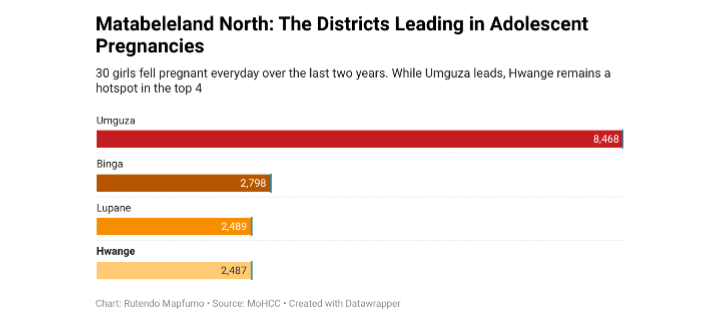
Source: Ministry of Health and Child Care/ZDHS Survey, 2025
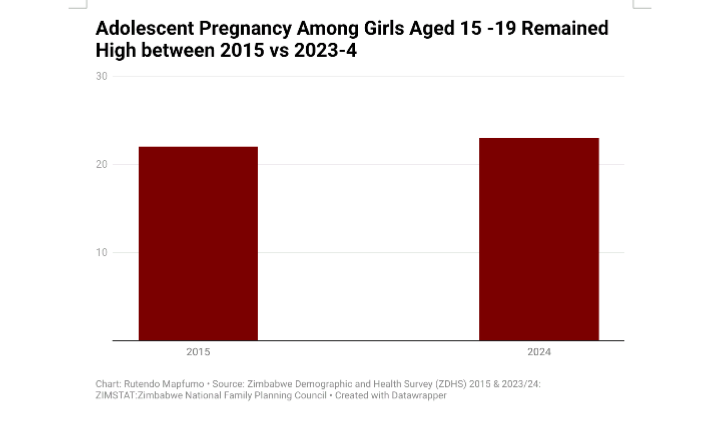
The scale of the crisis is clearer when set against national trends. The 2023–24 Zimbabwe Health Survey recorded the national teenage pregnancy rate at 23 percent — up from 21 percent in 2015. In Matabeleland North, the provincial rate is already at 25 percent. One in four girls here is becoming pregnant before she turns 18.
Umguza District accounts for 40 percent of the province’s cases. Hwange is in the top four, with 2,487 recorded pregnancies. A girl in a rural communal area is twice as likely to fall pregnant as her urban counterpart.
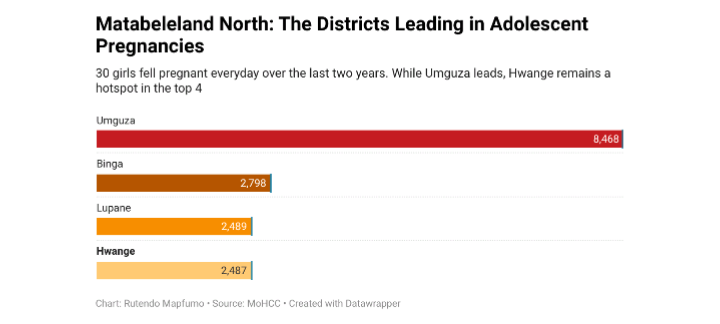
Source: Minister of State for Provincial Affairs Richard Moyo / Zimbabwe Ministry of Health and Child Care, 2025
At the root of the crisis is poverty so deep it reshapes family decisions daily. The Food and Nutrition Council reports that poverty prevalence in Hwange has surged to 71 percent — reaching 90 percent in areas like Ward 3. When household income falls as low as US$16 per month, school is often the first casualty.
Fees go unpaid. Uniforms wear out. Quietly, without anyone officially recording it, girls stop attending.
“When a girl is married, her future is compromised,” says Anna Mandizha Ncube, director of Bwalo Matalikilo Trust. Her words reflect a pattern the data confirms: 25.2 percent of school-age children in Matabeleland North are now out of school, the second-highest provincial dropout rate in Zimbabwe, according to the Zimbabwe Livelihoods Assessment Committee 2024 report.
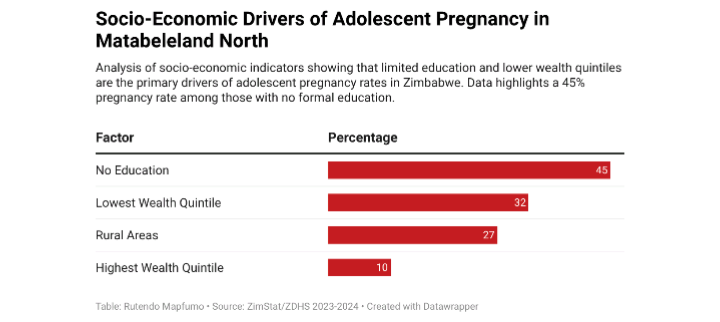
Sources: ZIMSTAT/Food and Nutrition Council 2025 / ZimLAC 2024 / Zimbabwe Demographic and Health Survey 2023–24
The consequences of leaving school are severe and measurable. The Zimbabwe Demographic and Health Survey found that 45 percent of girls with no formal education have experienced pregnancy — nearly double the rate of girls who completed secondary school. In the year ending December 2023 alone, 4,557 girls nationally dropped out of school because of pregnancy. Of those, 3,942 were from rural schools — girls whose schools had no early warning system, no counsellor, and no safety net.
Those are only the ones officially counted. Girls like Sekani, who simply fade away from attendance without formal withdrawal, never appear in that figure at all.
A separate crisis is closing school doors before pregnancy is even a factor. Basilwizi Trust, which works across the Zambezi Valley, found that 43 percent of children in the area lack birth certificates. Without one, a child cannot sit national examinations. Their schooling ends not through any choice of their own, but through administrative exclusion.
Basilwizi has been running its Citizens Campaign for Birth Identity Documents to address the backlog, identifying significant numbers of unregistered children in Binga alone. But the problem is structural, and the pace of intervention has not matched the scale of need.
“A girl without a birth certificate cannot write her O-Levels. She cannot open a bank account. She cannot register a business. She is administratively invisible. And when you are invisible, you are also unprotected. We have found children here who are fifteen, sixteen years old and have never appeared in any government record. They do not exist on paper. And it is very easy for very bad things to happen to people who do not exist on paper” an official from Basilwizi Trust revealed.
Wards 2,3,4,5 and 9 in Hwange still have no functional clinic within a 10-kilometre radius. Budget allocations for rural youth-friendly health services have not kept pace with population growth. Civil society groups say calls for mobile registration units and satellite health posts have gone unanswered at district level for years.
In 2024–25, government figures recorded around 3,400 girls pushed out of school by early marriage and pregnancy, including girls as young as 13. UNICEF’s 2024 Zimbabwe Annual Report noted that the child marriage rate for girls aged 15 to 19 remains at 21.2 percent, a figure that has barely moved despite years of policy commitments and documented advocacy.
The 2022 Marriage Act set 18 as the minimum marriage age. It was a meaningful reform. But a law passed in Harare reaches Hwange’s remote wards only if institutions are present to enforce it. They are not consistently there.
For Sekani Nyathi, none of those institutional failures had names or faces. They were simply the sum of every obstacle between her and the help she needed: the distance, the cost, the silence.
She has not returned to school. There is no one to watch her daughter while she attends class, and the school she attended has no re-entry policy for young mothers. She speaks of this detail with a calm that suggests she has already processed what it means for her life.
“I wanted to be a nurse. I still think about it. But thinking about something is not the same as it being possible.”
The numbers are no longer an abstraction. They are a map of where the province’s safety nets have frayed — in the classroom, in the registry office, in the clinic, and in the household. That fraying is not accidental. It is the consequence of policy gaps that were documented, flagged, and left unaddressed.
Without urgent budgetary intervention and a credible government response at district level, the next 21,000 cases are already taking shape. Behind every data point is a girl whose options narrowed faster than anyone intervened.