

Government Tightens Grain Import Rules, Mandates Full Local Sourcing by 2028

Matebeleland Pulse Reporter
The government has introduced new regulations to control the importation of grain, oilseeds and related products, while setting a phased requirement for processors to source all supplies locally by 2028.
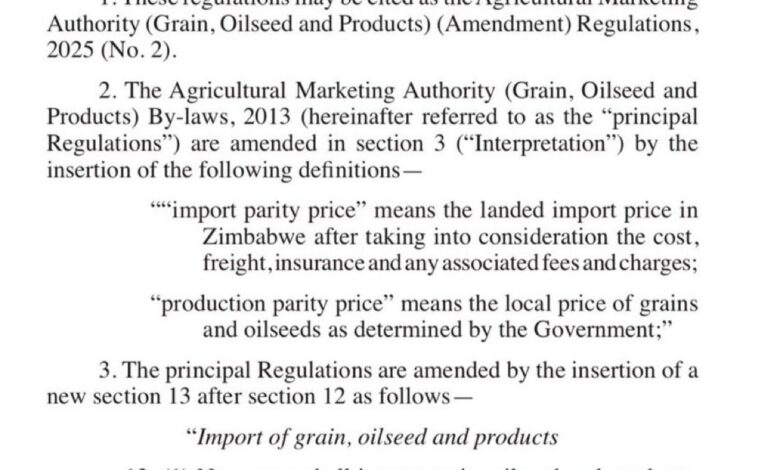
The measures, outlined in Statutory Instrument 87 of 2025, amend existing Agricultural Marketing Authority by-laws and introduce new definitions and import controls aimed at supporting domestic production.
The regulations define “import parity price” as “the landed import price in Zimbabwe after taking into consideration the cost, freight, insurance and any associated fees and charges.” They also define “production parity price” as “the local price of grains and oilseeds as determined by the Government.”
Under the new rules, authorities said “no person shall import grain, oilseed and products, except for contractors in instances of need,” effectively limiting private imports.The regulations further stipulate that where imported goods are cheaper than locally produced equivalents, “the difference shall accrue to the Agricultural Revolving Fund,” a mechanism intended to support the sector.
In a significant policy shift, the government introduced mandatory local sourcing thresholds for processors. “With effect from 1st April, 2026, all processors must source at least forty per centum of their annual requirements… locally,” the document states.
This requirement will increase over time, with the regulation adding that “with effect from 1st April, 2028, one hundred per centum of all annual requirements… must be sourced locally.”The changes signal a stronger push by the government to reduce reliance on imports and boost domestic agricultural production.