Michelle Moyo
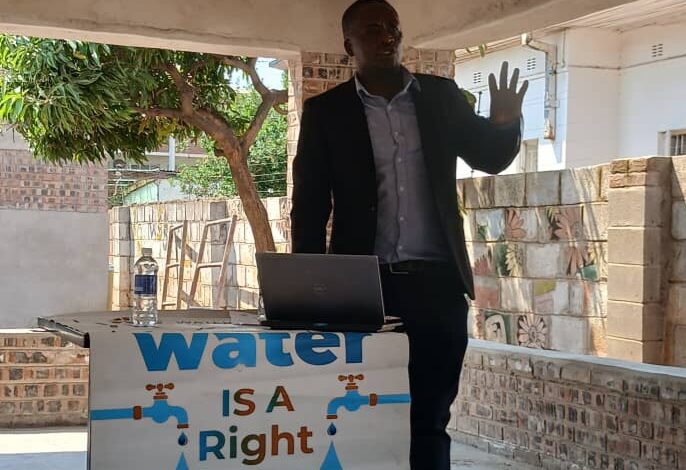
BULAWAYO – The Matabeleland Institute for Human Rights (MIHR) has engaged Bulawayo City councillors on water privatisation, examining its different forms, experiences from other African countries and implications for water service delivery.
The engagement, held on Wednesday at Scripture Union offices in Bulawayo, also addressed local authority powers, water infrastructure costs, mining-related water demand and concerns surrounding prepaid water meters.
MIHR Director and Coordinator Khumbulani Maphosa defined water privatisation as the transfer of ownership, management, or control of water services from public institutions to private companies.
He said privatisation could take different forms, including service contracts, management contracts, leases, concessions, and the full transfer of infrastructure ownership.
“Water privatisation is about handing over public water to private companies. It takes different forms, including service contracts, management contracts, leases, concessions, and full divestiture where a company buys the infrastructure,” he said.
Maphosa argued that privatisation risked turning water from a public good and a human right into a profit-driven service.
“Water privatisation turns water from a public good and a human right into a private profit-making business,” he said.
He cited experiences from Tanzania and Ghana to illustrate the challenges associated with some private sector arrangements in water service delivery.
In Tanzania, the government terminated a 10-year lease with City Water Services in June 2005, approximately 21 months after the contract began. The arrangement had encountered difficulties relating to contractual performance and service delivery.
Maphosa said the experience demonstrated the risks of relying on private investors to improve water services.
He also cited Ghana’s five-year water management contract, which ran from 2006 to 2011. Ghana Water Company Limited reported that non-revenue water remained at approximately 50% when the contract ended, despite a target to reduce it to around 25%.
Non-revenue water refers to water supplied into a distribution system that does not generate revenue, including losses through leaks, theft, and metering inaccuracies.
Maphosa said residents and councillors needed reliable information to assess different approaches to water management.
“My duty is not to say popular things. My duty is to put facts on the table so that councillors and residents make informed decisions. We must protect water as a common good,” he said.
Ward 5 Councillor Octavius Dumisani Nkomo called for greater powers for local authorities, arguing that councils faced challenges in delivering water services within the existing governance framework.
“In the UK, they are also saying no to privatisation, but they are saying give more power to local authorities. Our councils have eyes open but hands tied because of the water governance architecture. We need to advocate for devolution,” he said.
Nkomo said Bulawayo needed almost US$1 billion to rehabilitate its ageing water infrastructure, raising concerns about the city’s ability to meet the costs.
“We cannot afford that kind of money in the next five years. We are expected to provide water 20 hours a day with no money, while ZINWA controls raw water. How do we do that?” he said.
His remarks highlighted concerns about the division of responsibilities between local authorities and the Zimbabwe National Water Authority (ZINWA), particularly regarding raw water supply and the distribution of treated water.
Councillor Adrian Rendani Moyo raised concerns about the pressure that mineral processing places on Bulawayo’s limited water supplies.
He said mining activities, particularly mineral processing, could increase demand for water in a city already facing supply constraints.
“Mineral processing uses a lot of water. Small scale miners use a lot of water, so you can imagine large operations can need a whole dam to themselves. That puts pressure on Bulawayo’s already limited supply,” he said.
Moyo also discussed the potential introduction of prepaid water meters, saying council discussions had focused on whether to adopt the technology rather than how to implement it effectively.
“We have been debating whether we want prepaid meters or not, but we have not been discussing how to benefit from them. Technology is evolving, and we can not run away from it,” he said.
He raised concerns that air moving through water pipes when supplies are restored after scheduled interruptions could cause some meters to register consumption inaccurately.
“Air trapped in pipes when water supply is restored after shedding can cause high charges on prepaid meters. We need specialists to test meters in that situation because residents should not pay for air,” he said.
Research has documented cases in which air passing through certain mechanical water meters caused over-registration. However, the extent of the problem depends on the meter design and operating conditions.
Moyo said adequate supporting infrastructure would be necessary for prepaid meters to function effectively.
“Prepaid meters need supporting infrastructure to work, like a cellphone needs a base station. Without that architecture, the meter becomes useless. We need that full infrastructure before we roll out,” he said.