Zimbabwe Introduces Securitised Title Deeds to Strengthen Property Ownership Protection

By Staff Reporter
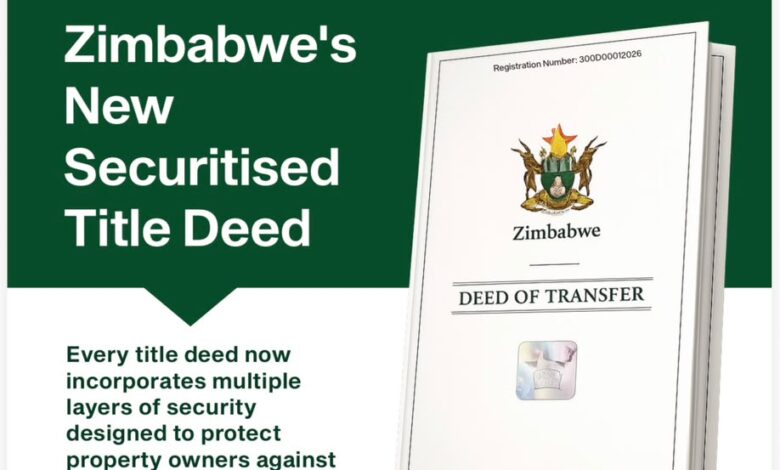
HARARE, Zimbabwe: Zimbabwe is introducing a new generation of securitised title deeds containing multiple layers of security intended to make property records harder to forge, alter or counterfeit.
The initiative is being implemented through the Department of Deeds, Companies and Intellectual Property’s Digital Land Administration Platform (DLAP). The new documents use security technologies similar to those found on banknotes, passports and other high-security government documents.
According to information issued by the department, the programme is intended to strengthen the integrity of land-ownership records, improve document traceability and make property records easier to authenticate.
Land is among Zimbabwe’s most important economic assets, supporting residential ownership, commercial development, agriculture and investment. Ensuring the integrity of title deeds is therefore essential to protecting legitimate owners and building trust in property transactions.
Multiple layers of security
The securitised title deed combines physical and visual features designed to deter unauthorised reproduction.
One of its most prominent elements is a holographic Zimbabwe Bird that changes colour and appearance when viewed from different angles. This provides an immediate visual indicator that can help distinguish an official document from a counterfeit.
The deed also contains six Zimbabwe Bird images that are visible under ultraviolet (UV) light, along with additional UV-sensitive lettering. These features provide further means of checking the document’s authenticity.
Microtext printed along the deed’s double-line border identifies the type of document and can be read under magnification, adding another barrier against counterfeiting.
The deed is printed on durable, tear-resistant and waterproof security paper designed to withstand routine handling and exposure to moisture. Its exterior also includes a unique registration number, the national coat of arms, Zimbabwean imagery and clearly displayed deed information to support initial visual checks.
Together, these features are intended to improve document security and help officials and other authorised users identify irregularities.
QR code connects physical deeds to digital records
A key feature of the new deed is a Quick Response (QR) code linking the physical document to its corresponding official digital record.
According to the department, authorised users will be able to scan the code using a dedicated application and compare the official record held by the Department of Deeds with the information shown on the physical deed.
This is important because the appearance of a document alone does not confirm that its contents correspond with the official registry. Linking the paper deed to a digital record provides an additional verification mechanism for property owners and authorised participants in property transactions.
The department’s published information states that the QR-code scanning application will be made available to the public through its website. Users should confirm its availability and operating procedures through official departmental channels before relying on it for verification.
Unique numbers improve traceability
Each securitised title deed carries both a unique serial number and a unique registration number.
These identifiers are intended to support document tracking, verification and official record management. They can also help distinguish individual deeds and identify specific documents when questions arise about their authenticity.
The combination of unique identifiers, physical security features and digital verification offers a more comprehensive approach to document protection than relying solely on the appearance of a paper deed.
For property owners, the system could provide an additional safeguard against forged or unlawfully altered documents. For institutions involved in property transactions, the ability to compare deeds with official records could strengthen due diligence, provided the underlying registry is accessible, accurate and properly administered.
Implications for banks and investors
The introduction of securitised title deeds could affect more than individual property owners.
Banks and other financial institutions routinely review ownership documents when assessing property loans and security arrangements. Investors likewise need assurance that the assets they are acquiring or financing are supported by authentic and verifiable records.
A system that makes document authentication more accessible and dependable could reduce uncertainty during property transactions and increase confidence among lenders, conveyancers and investors.
Secure documents, however, cannot eliminate every form of property fraud. Effective protection also depends on accurate official records, appropriate access controls, reliable administrative procedures and proper due diligence by all parties.
The long-term success of the system will therefore depend not only on the security features printed on each deed, but also on the performance of the digital platform and the processes used to verify ownership.
What property owners need to know
The department’s guidance sets out different procedures for obtaining a securitised title deed, depending on an owner’s existing documentation and the programme under which the property is being processed.
Under the Title Deed Validation and Securitisation process, applicants are instructed to prepare their original title deed and a valid national identity document or passport, appoint a conveyancer of their choice and pay a stated fee of US$200, excluding value-added tax (VAT).
Applicants under the Land Tenure Programme are directed to the One Stop Centre at Makombe Complex in Harare. The stated requirements include completing a data-collection form, submitting certified copies of identity documents and presenting the relevant tenure document—such as a 99-year lease, offer letter or A2 permit—along with the applicable processing fee.
Under the Kwangu/Ngakwami Presidential Title Deeds Programme, applicants should approach their local field office or council offices with their personal details, stand location and proof of occupation or residence to begin the process.
Property owners should confirm the latest fees, eligibility criteria, processing arrangements and documentation requirements with the relevant authorities before making payments or submitting original documents.
The department also makes an important distinction: once the validation process is completed, the securitised deed replaces the existing non-securitised deed, but it does not itself transfer ownership to another person.
In other words, the process is intended to validate and secure the ownership document, not automatically change who owns the property.
A step towards modernising land administration
The introduction of securitised title deeds represents a broader move towards combining traditional property documentation with modern authentication and digital record-management systems.
For Zimbabwe, the potential benefits include stronger protection for homeowners, improved land-record administration and greater confidence among participants in property transactions.
The new deeds offer several ways to assess authenticity, including the holographic Zimbabwe Bird, ultraviolet markings, microtext, unique identification numbers and digital record verification.
The public is nevertheless encouraged to use official verification channels rather than relying solely on visual inspection or possession of a document that appears genuine.
For assistance, the department’s published information lists the National Deeds Call Centre at 08677212440.
As implementation continues, the system’s success will ultimately be judged by how effectively it protects legitimate property owners, maintains accurate records and makes property-document verification more reliable.
The message for property owners is clear: protecting land ownership requires more than a secure document. It also depends on accurate records and proper verification.