Peter Moyo
VICTORIA FALLS — Africa must lower the cost of capital, integrate its fragmented electricity systems and develop more of the technologies needed for the renewable-energy transition if the continent is to turn its vast solar resources into economic growth, African Union Commissioner for Infrastructure and Energy Lerato Dorothy Mataboge said on Wednesday.
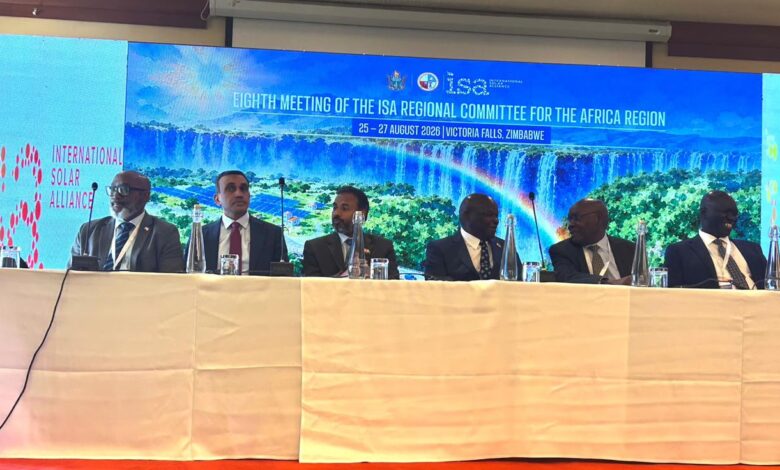
Speaking at the official opening of the eighth meeting of the International Solar Alliance’s Regional Committee for Africa in Victoria Falls, Mataboge said Africa’s shift to solar power should be treated as an industrialisation strategy, rather than simply an effort to connect more households to electricity.
“The sun already shines on Africa,” Mataboge told delegates. “Our responsibility, therefore, is to ensure that this power also drives Africa’s prosperity.”
The three-day meeting, hosted by Zimbabwe from August 25 to 27, brings together governments, development partners and energy-sector stakeholders to discuss how to accelerate solar deployment, mobilise investment and expand electricity access. Key areas of focus include financing, project preparation, technical assistance, battery storage, grid integration and country-level partnerships.
For Mataboge, the central question is whether Africa can translate its enormous solar resource into “reliable power, productive capacity and shared prosperity.”
“Energy is not simply one development sector among many,” she said. “Energy is the infrastructure that makes development possible.”
Africa cannot industrialise, beneficiate its mineral resources or develop competitive manufacturing, modern agriculture and digital economies without reliable and affordable electricity, she said.
“Electricity access, therefore, is not the end of our ambition. It is the beginning of economic transformation.”
Her comments highlight a central challenge facing Africa’s energy transition. Although solar technology has become increasingly affordable and deployment is expanding, many projects on the continent still struggle to secure financing, connect to electricity grids and achieve the scale needed to drive wider economic transformation.
The International Solar Alliance has identified financing and project bankability as major constraints to scaling solar investment in Africa. Its current regional programme is also focused on moving from commitments to a pipeline of projects that can attract investment.
“Our greatest constraint remains finance, and particularly the cost of capital,” Mataboge said.
Public and concessional finance should therefore be used more strategically to reduce risk and attract private investment, she said. African governments should also deepen local capital markets, mobilise pension and institutional funds, and continue pressing international financial institutions to reconsider how risk is assessed and priced in African markets.
That argument aligns with the ISA’s push to operationalise the Africa Solar Facility, which is intended to expand access to blended finance, project-preparation support and investment facilitation for solar projects across the continent.
Mataboge used Zimbabwe, the host country, to illustrate how solar power can serve different parts of the economy. The country’s renewable-energy plans include utility-scale generation, industrial projects and decentralised systems for communities far from the national grid.
She cited solar developments supplying mining and other productive activities as examples of the technology moving beyond household lighting and into the productive economy.
“These important examples show solar moving beyond household lighting and becoming productive infrastructure for industry,” she said.
She also pointed to solar mini-grids as a way of supplying electricity to schools, clinics and other institutions in communities where extending the conventional grid could take years.
“This is what an inclusive energy transition should look like; national-scale ambition combined with practical solutions to reach people where they live.”
Africa should not pursue a single model of solar deployment, Mataboge said.
“We need utility-scale solar connected to stronger national and regional grids,” she said. “We need distributed generation for industry and commerce. We need mini-grids and standalone systems for communities beyond the reach of the grid.”
The continent also needs energy-storage systems, stronger transmission networks and electricity markets capable of moving power across borders.
Those objectives are central to the African Union’s efforts to develop the African Single Electricity Market and implement the Continental Power System Master Plan, with the longer-term goal of moving from largely national electricity systems towards greater regional integration.
Marie-May Jeremie, Seychelles’ minister responsible for environment, climate, energy and natural resources and chair and vice-president of the ISA Assembly for Africa, said the region’s energy transition was gaining momentum but remained far below its potential.
“Solar energy can expand electricity access, support agriculture, strengthen health and education services, power enterprises and build resilient communities,” Jeremie said.
She said the Victoria Falls meeting should help turn Africa’s abundant sunlight into “investable projects and measurable development outcomes.”
For island nations such as Seychelles, she added, solar generation, energy storage and stronger electricity systems are also important for reducing dependence on imported fuels and addressing climate vulnerabilities.
Zimbabwean President Emmerson Mnangagwa, who officially opened the meeting, also called for faster investment in solar power, arguing that Africa must use its renewable resources to address electricity shortages, support industrialisation and improve livelihoods.
He said the continent’s energy transition should be measured not only by the amount of generating capacity installed, but also by the businesses, jobs and economic opportunities created.
India’s Ambassador to Zimbabwe, Bramha Kumar, meanwhile pointed to India’s own energy transition as an example of how sustained policy and investment can accelerate renewable-energy deployment.
The International Solar Alliance, co-founded by India and France, has positioned itself as a platform for cooperation on solar energy, climate action and energy access among countries of the Global South.
For Mataboge, however, Africa’s ambition must go beyond becoming a major market for imported solar technologies.
“Our energy transition must also be an industrialization strategy. We must ensure that we produce what we need for solar scalability on the African continent. Solar energy is indispensable to Africa’s ambitions,” she said.
The challenge now, she suggested, is not whether Africa has enough sunlight, but whether it can build the financing systems, infrastructure and local industrial capacity needed to turn that resource into reliable electricity and broad-based economic growth.