Ending the Darkness: Zimbabwe Targets End to Power Imports by 2027 as Private Energy Projects Gather Momentum

Thembelihle Mhlanga
Zimbabwe is targeting an end to electricity imports by December 2027, with the Government banking on a growing pipeline of private-sector energy projects, renewable power investments and upgrades to existing generation infrastructure to strengthen national electricity supply.
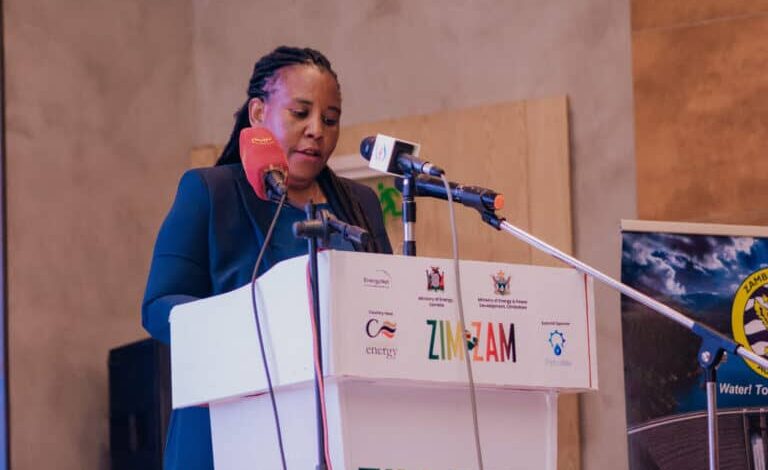
The goal was outlined by Deputy Minister of Energy and Power Development Yeukai Simbanegavi, who officially opened the third Zimbabwe-Zambia Energy Projects Summit (ZimZam) in Livingstone, Zambia, on Tuesday. Addressing regional delegates, energy experts and investors, Simbanegavi said Zimbabwe was pursuing a more competitive and investment-friendly energy market as it seeks to reduce dependence on imported electricity and improve security of supply by the end of 2027.
For communities across Matabeleland and the broader southern region—where the sting of load-shedding and climate-induced droughts have long disrupted daily life and local enterprise—the strategic push rests on a massive 1,365MW private generation pipeline currently taking shape across the country. Of this incoming capacity, 635MW is actively under construction while 730MW is rapidly progressing toward financial close.
Simbanegavi told delegates that switching away from speculative and unsolicited project proposals toward transparent competition would move the market “away from speculative and unsolicited project proposals towards transparent competition, credible developers and bankable projects.”
The bulk of this incoming non-hydro capacity is driven by major industrial and mining investments, sectors heavily anchored in the coal and solar belts of Matabeleland North and South. As outlined earlier by ZESA Chief Executive Cletus Nyachowe, private firms are rapidly building out captive power plants to insulate their operations from regional grid shocks. While coal continues to shoulder the immediate base-load heavy lifting, utility-scale solar installations and plant upgrades are projected to outpace original targets.
This aggressive shift comes at a critical juncture for the region. With another El Niño cycle threatening below-normal rainfall, the Zambezi River Authority has announced a dramatic 36 percent cut in water allocations for hydroelectric generation at Kariba next year.
Simbanegavi emphasized that these dwindling water levels make a strong case for urgent action, noting that the drop in hydroelectric output “demands an aggressive drive towards increasing non-hydro generation projects such as solar and wind generated power plants,” as well as faster progress on joint cross-border ventures like the long-awaited Batoka Gorge Hydro Electric Scheme.
To accelerate energy projects, government reforms have stripped away long-standing financial roadblocks for independent developers. Under Statutory Instrument 125 of 2026, the greenfield and the brownfield licence application fees set at US 2500 and US2000 respectively were reduced to a single application fee of US20. More significantly, commercial renewable projects producing under 10MW and those built for a company’s own consumption are exempt from generation licence fees. n.
Furthermore, with technical assistance from the World Bank secured in late 2025, Zimbabwe is rolling out competitive bidding for at least 140MW of grid-connected solar within a broader 370MW pilot framework. This initiative aims to establish standardized, bankable agreements—much like the 30MW Vungu Solar Project in the Midlands, which secured a Government Project Support Agreement and a 25-year Power Purchase Agreement with ZETDC.
Looking ahead under the second National Development Strategy (NDS2), which runs from 2026 to 2030, the government aims to raise total generation capacity from about 2,950MW to 6,000MW. This expansion will be supported by extending the transmission network by 1,715km, including the critical Hwange B to Sherwood B 330kV line that traverses the heart of Matabeleland.
To secure long-term regional stability, Zimbabwe is also advancing key cross-border interconnectors, including the ZIZABONA project linking Zimbabwe, Zambia, Botswana, and Namibia, and the MOZISA interconnector with Mozambique and South Africa. Backed by Zimbabwe’s National Energy Compact under Mission 300—which aims to mobilize over US9 billion, including US4.42 billion from the private sector—the roadmap to 2027 sets a fast-paced track toward a reliable, home-grown power supply for local industries and households alike. Closing her address on the deep bonds tying the two neighboring nations together across the Zambezi, Simbanegavi remarked, “The veins that knit us together are stronger than the borders that demarcate us.”