

Zimbabwe’s ICT Survey Reveals Widespread Mobile Phone Ownership, but Computer Access Remains Limited


Peter Moyo
Mobile phone ownership in Zimbabwe has reached near-universal levels, but computer access remains low, according to the latest ICT Access by Households and Use by Individuals Survey Report, released jointly by the Postal and Telecommunications Regulatory Authority of Zimbabwe (POTRAZ) and the Zimbabwe National Statistics Agency (ZIMSTAT).
Sharing key findings, POTRAZ said: “The survey revealed that 96.4% of households now own a mobile phone and 75.5% have internet at home. 80.0% have a radio and 30.3% have a TV. Just 11.2% of households own a computer (laptops most common, 84.4%) and 92.2% of home internet users connect via mobile handset broadband.”
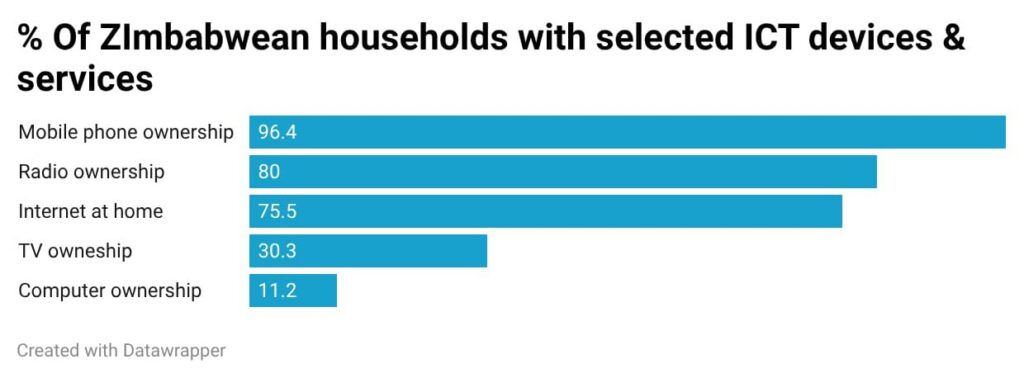
The figures suggest that while digital connectivity has expanded significantly, most Zimbabwean households continue to rely primarily on mobile devices rather than computers to get online.
The survey, jointly conducted by ZIMSTAT and POTRAZ, is part of a broader effort to measure how households and individuals access and use ICTs across the country. ZIMSTAT states that the survey aims “to produce statistics on access to and use of ICTs by households and individuals in order to determine the level of the digital divide in the country.”
Fieldwork for the 2025 survey ran from 6 to 23 November, following a household listing exercise in October. The survey also examined barriers to ICT access and usage, and tracked changes in adoption over time.
Speaking at the report’s launch, POTRAZ Director General Dr Gift Machengete said the findings would support evidence-based policymaking and digital inclusion efforts. “The survey findings will help ensure that no community is left behind,” he said.
The finding that 92.2% of internet-connected households rely on mobile handset broadband underscores the dominant role mobile networks play in Zimbabwe’s digital landscape. The survey is expected to inform government, regulators, the private sector, and development partners as they work to expand digital infrastructure and close gaps in technology access.
