Jonathan Sibanda
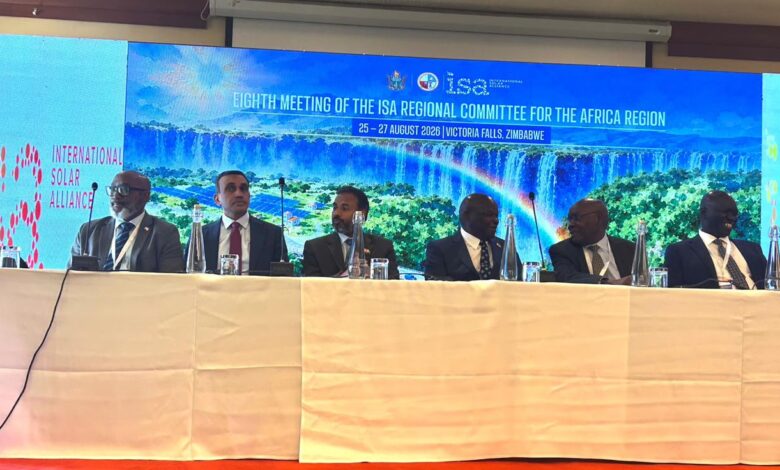
VICTORIA FALLS — Africa must move beyond exporting raw critical minerals and invest in manufacturing, technology and energy infrastructure to capture more value from its natural resources, speakers at the International Solar Alliance (ISA) Regional Committee meeting in Victoria Falls have said.
The call comes as African countries seek to expand renewable energy while strengthening regional electricity networks to support industrialisation and greater local value addition.
ISA Director General Ashish Khanna said Africa’s mineral wealth was not being matched by sufficient collaboration in finance, technology and skills to build competitive regional supply chains.
«“Africa has the minerals, Europe has the money and the R&D and India has the human skill. But they are not collaborating to create a supply chain that can be very useful for these countries.”»
Khanna said fragmented supply chains had contributed to the concentration of photovoltaic (PV) and battery manufacturing in a small number of countries.
“80 to 90% of all manufacturing of PV and batteries are concentrated in only one country today.”
He said the ISA would undertake a dedicated study on Africa’s critical minerals and opportunities for localising value addition.
“We will do a specific study only on Africa for both critical minerals and localisation of value addition.”
Khanna said Africa needed to combine its natural resources with international finance, technology and expertise to develop manufacturing capacity on the continent.
He cited Nigeria’s Dangote Refinery as an example of the potential for large-scale industrial value addition in Africa.
“I would like a lot of that manufacturing and collaboration to happen between these countries.”
Energy and Power Development Minister July Moyo said Zimbabwe was already taking steps to capture more value from its mineral resources, with the Government directing that lithium should not be exported in raw form.
“Our president has already directed that no lithium will be exported as raw and we now are producing lithium sulphate.”
Moyo said the next step was to develop domestic battery manufacturing, which he linked to the expansion of renewable energy.
“The next stage is to produce a lithium battery so that this renewable energy, especially solar, can be supported by battery.”
Zimbabwe currently imports batteries, but Moyo said the country’s mineral resources provided an opportunity to develop domestic manufacturing capacity.
“We think that Africa is ready to have its own battery manufacturing given the resources that are there in Africa and what we are producing in Zimbabwe.”
He said beneficiation should extend beyond lithium to minerals such as nickel, cobalt and iron ore.
“Whether it’s nickel or cobalt or we are talking about iron ore into steel, stainless steel, all these are avenues which we can make sure that the resources are here. Let’s beneficiate them.”
Moyo said mineral beneficiation and industrialisation would also require stronger electricity transmission systems within and between countries.
He said Southern Africa was working towards completing a network of interconnectors linking countries including Tanzania, Zambia, Angola, Namibia, the Democratic Republic of Congo, Malawi and Mozambique.
The proposed Tanzania-Zambia interconnector would also provide a link between the Southern and Eastern African power systems, while further connections could eventually link the continent’s regional power pools.
“We are also connecting again by strengthening the interconnectors among our countries and so we believe that the resources are here. We need investors.”
Moyo said Zimbabwe needed investment and technology transfer to turn its mineral resources into manufacturing capacity.
“We need ISA to actually come and work with us.”
He said Zimbabwe could draw on experience from India and other countries in technology, research and development and manufacturing.
The push for stronger regional electricity interconnection also aligns with the African Union’s longer-term African Single Electricity Market (AfSEM) agenda, which seeks to integrate the continent’s regional power pools.
AU Commissioner for Infrastructure and Energy Lerato Mataboge said Africa should view solar as part of a broader energy system rather than as a standalone solution.
She said the continent’s future energy mix would include solar, hydro and potentially nuclear power, with integrated power pools allowing countries to share generation capacity.
“So I need you to look at it as a contributor to energy security instead of a standalone solution for energy on the continent.”
She added:
“That won’t be practical to industrialise with solar alone.”
The discussions in Victoria Falls point to a broader industrialisation challenge for Africa: the continent’s mineral and renewable-energy resources can support economic transformation, but doing so will require investment in manufacturing, technology, skills, supply chains and electricity infrastructure that enables countries to retain more value from their resources.