

UNFPA Sounds Alarm Over 100 Million ‘Legally Invisible’ African Women at Victoria Falls Summit

Thembelihle Mhlanga
More than 100 million women and girls across West and Central Africa remain “legally invisible” as deeply entrenched traditional and religious unions continue to overshadow state-sanctioned civil registrations, a senior United Nations expert has revealed.
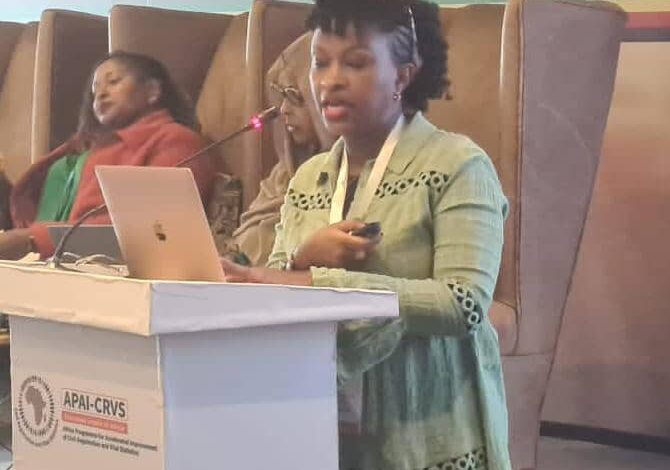
Speaking at the ongoing Annual Expert Group Meeting for African Registrars General (EGMRG) in the resort city of Victoria Falls, Violet N. Kinuthia, the Technical Specialist and Manager for the Centre of Excellence for Civil Registration and Vital Statistics (CRVS) Systems at the United Nations Population Fund (UNFPA), painted a stark picture of the continent’s fragmented marriage and divorce registration systems.
Presenting the findings of a comprehensive multi-region assessment spanning the Arab States, West and Central Africa, and East and Southern Africa, Kinuthia warned that the coexistence of parallel legal systems is creating dangerous “statistical black holes.” Zimbabwe is not spared in this crisis, as structural and cultural hurdles continue to keep thousands of local customary unions off the official state ledger.
Locally, Zimbabwe legally recognizes four distinct unions: the Civil Marriage, the Registered Customary Marriage, the Unregistered Customary Marriage, and the newly introduced Civil Partnership. However, a major statistical gap persists because only Civil and Registered Customary marriages successfully find their way into the official database managed by the Registrar of Marriages. This leaves the vast majority of traditional and domestic unions completely undocumented, severely undermining the state’s vital statistics and leaving women exposed.
“We are busy getting married in our culture and our traditions, but the state is waiting for certain records that are civil in nature,” Kinuthia told delegates. “While customary marriages enjoy deep-rooted and widespread social legitimacy, civil marriages are moderately perceived, often viewed merely as unnecessary bureaucracies.”
According to the UNFPA assessment, this disconnect creates severe gaps in human rights protection, particularly regarding property rights and inheritance for vulnerable women. Kinuthia cautioned African governments against relying on short-term fixes, such as accepting basic affidavits or traditional documents for routine daily transactions.
“Accepting non-civil documents for routine daily transactions removes the public incentive to complete the official civil registration,” she warned. “Many countries have gone for short-term fixes… but does that really protect human rights, spousal rights, and the rights of women? No. The long-term threat is that it will depress actual registration.”
The lack of robust civil registration data also severely limits the continent’s ability to track and combat critical social issues like child marriage. While data captures a 34% child marriage rate in Uganda, many neighboring countries show zero records not due to the absence of the practice, but because the unions simply do not exist on paper.
Kinuthia highlighted a cultural mindset block prevalent in many communities, quoting a respondent from Benin who stated, “Once I have done my religious one, I am at peace with God. Why do I need to tell the government?”
To bridge this divide, the UNFPA Centre of Excellence is preparing to roll out the Africa Regional Guidance on Marriage and Divorce Registration Systems, an operational manual designed to harmonize customary systems with civil registries. Registrars at the Victoria Falls meeting will review and validate the draft document ahead of its formal launch.
The presentation also showcased successful innovations across the continent that Zimbabwe and other nations could replicate. Rwanda, South Africa, and Lesotho were lauded for pioneering “one-stop shops” for civil unions. Kinuthia shared her firsthand experience observing a seamless registration process in Lesotho.
“I actually sat through a marriage ceremony. From there, the couple was told to go and take pictures just outside as the civil event was being registered. They came back and were issued with an e-certificate, still in their beautiful clothes. That is a one-stop shop. That’s what we need to begin to work with.”
Other highlighted solutions included Uganda and Kenya’s approach of licensing faith and traditional leaders as official civil informants, requiring them to submit monthly returns to national registration bureaus. Kinuthia concluded by urging a swift transition toward secured digital ecosystems and the integration of unique identification numbers to prevent the double-registration of customary and civil unions.