

The Waiting Room is Full: It is Time to Build Your Own Door
A frank conversation with Matabeleland's young people about money, survival and the gaps hiding in plain sight

Peter Moyo
Let us begin with the truth most people avoid saying out loud: the job you are waiting for may not be coming.
Depending on who is counting — and how — Zimbabwe’s unemployment crisis looks very different on paper. ZimStat officially recorded unemployment at 21.8% in the third quarter of 2024. But independent researchers and labour organisations tell a starkly different story. The IndustriALL Global Union, pointing to the collapse of formal manufacturing and the widespread closure of factories, reported that unemployment in Zimbabwe was nearing 90%. The BBC once captured the debate bluntly, noting that unemployment estimates used in Zimbabwe range from 5% to 95%, depending entirely on how the term is defined.
What is less disputed is this: according to the Zimbabwe National Chamber of Commerce, 80% of jobs in Zimbabwe are in the informal sector, providing low pay and little security, and an estimated two-thirds of the population rely on that sector for daily income.
For young people in Bulawayo and across Matabeleland, those numbers are not abstract. They are felt every morning that a CV goes unanswered.
According to World Bank data, approximately 60% of Zimbabwe’s population is under 25 years of age, and the youth unemployment rate among those actively seeking work stands at 41%. But that figure only counts those still looking. It excludes the many who have already given up. The real picture in Matabeleland is harder than any single statistic can capture.
This column is not written to discourage you. It is written because false hope is more dangerous than hard truth. And the hard truth, once accepted, becomes the foundation of something real.
Bulawayo is not Harare. That sentence carries weight that young people from this region understand instinctively. The city’s industrial base, once the backbone of Zimbabwe’s manufacturing sector, has been hollowing out for decades. Large employers have either scaled down or closed entirely. The formal jobs that remain are fiercely contested. Research by Catalystas Consulting, commissioned by the Netherlands Embassy in Zimbabwe in 2023, found that 41.8% of Bulawayo’s population was living in poverty, with young entrepreneurs in the city facing deeper challenges accessing markets and financial services than their counterparts in Harare. The same research found that when Bulawayo businesses get serious about growth, many entrepreneurs relocate to Harare to access both financing and markets — a brain drain that continuously strips the region of its most ambitious young talent.
But staying and building here is not only possible. For those willing to think carefully, it is a strategic advantage. While everyone else chases Harare, Bulawayo’s gaps remain unfilled and available.
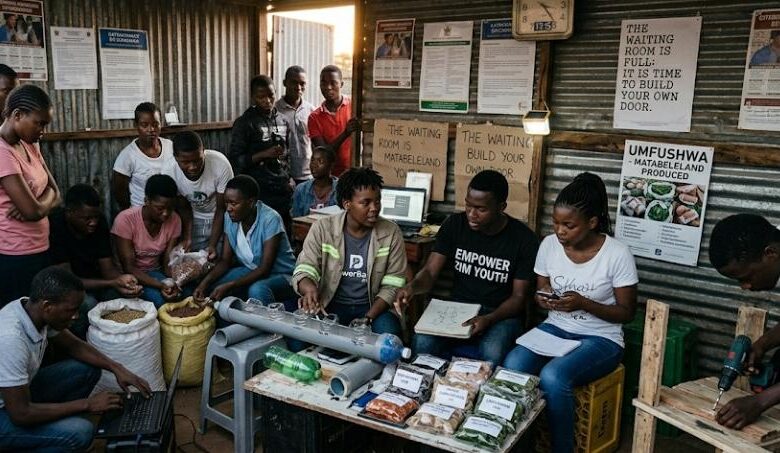
Take the food economy. Bulawayo feeds itself largely through informal channels. Wholesale markets, roadside vendors, and home-based food producers fill the gaps that formal supermarkets do not. Yet the value chain between producer and consumer remains poorly organised, inconsistently supplied, and wide open for young people who can add reliability, packaging, or delivery. Think beyond selling tomatoes. Think about the person who aggregates produce from ten small growers, packages it consistently, and delivers to tuckshops on a weekly schedule. That person is not a vendor. That person is a distributor — and distributors make margins that vendors never see. Traditional Ndebele foods — umfushwa, amahewu, sorghum-based products — are in growing demand both locally and among the diaspora. The Catalystas research found that more youth-run businesses in Bulawayo focused on fabrication and production of goods compared to other Zimbabwean cities. The production instinct exists here. What is often missing is marketing thinking and basic business structure.
The land itself is also an asset that Matabeleland youth consistently underestimate. Matabeleland South and North have agro-ecological characteristics suited to drought-resistant crops: sorghum, millet, groundnuts, sunflower, and small livestock. The mistake most young people make is farming what everyone else farms, the way everyone else farms it, then competing on price alone and losing. The smarter approach is identifying who wants what, then working backwards from the buyer to the field. Tourism lodges near Hwange and Victoria Falls need consistent locally sourced fresh produce and frequently struggle to find reliable suppliers. Schools and government institutions need catering supplies on contract. The districts of Binga, Lupane, and Umguza have livestock populations that could support a more organised small-scale butchery and supply network. None of this requires a degree. All of it requires reliability and basic written agreements. A recent EU-funded Green Jobs Boot Camp brought together 25 young people from Matabeleland North, Matabeleland South, Bulawayo, and Beitbridge for training in climate-smart agriculture and green business development. One standout participant was Ntombifikile Ncube, a hydroponics farmer and innovator from Bulawayo — proof that the ideas and the people are already here.
Then there are the trades that degree-holders consider beneath them. New residential developments and retail activity in areas like Cowdray Park and Emganwini are generating consistent demand for tiling, plumbing, electrical work, painting, and garden maintenance. A skilled tiler or plumber working independently in Bulawayo can earn more in a week than a junior office clerk earns in a month — and answers to no one but their client. The Bulawayo Polytechnic and Mzilikazi Arts and Crafts Centre both offer relevant training. The investment is months, not years.
The digital economy, finally, does not care where you live. Transcription, virtual assistance, graphic design, social media management, and content writing can all be sold to clients in South Africa, the United Kingdom, or the United States — from a phone or laptop in Luveve or Nkulumane. Recognising this gap specifically for this region, Magara AI — whose chief executive Peaceful Ngara was raised by a single mother from Bulawayo — launched a fully funded, internationally certified digital skills mentorship programme exclusively for Matabeleland residents in 2026, offered free of charge. Ngara noted that the region has endured decades of limited educational and economic opportunities, resulting in low representation in technology fields. Opportunities like this are rare. The barrier most Bulawayo youth face is not access — it is awareness that these markets and programmes exist, and the patience to build a skill over three to six months before income flows. That patience is rare, which is precisely what makes it valuable.
Start with what you already have — a skill, your labour, a family plot, or access to a commodity. Generate the first small income by selling a service before investing in a product. Reinvest every dollar for the first year. Build a track record that is written down and provable.
Once that track record exists, formal options open up. EmpowerBank — Zimbabwe’s only youth-oriented microbank, regulated by the Reserve Bank of Zimbabwe — offers a Youth Business Starter Pack covering poultry, horticulture, tobacco, and mining equipment sectors, priced 5% lower than standard loan rates with repayment periods of up to 18 months. Their Bulawayo office is reachable at +263 292 260928 or info@empowerbank.co.zw. In April 2026, the government launched a US$1 million Youth Economic Fund administered by EmpowerBank, designed to reach young entrepreneurs across all ten provinces. The ILO’s Business Growth for Young Entrepreneurs programme has already impacted over 1,000 entrepreneurs and generated more than 2,200 jobs across districts including Bulawayo and Umguza, combining financial literacy training with access to credit.
A 2026 academic study published in a peer-reviewed international journal examined how graduate youth in Bulawayo navigate the city’s informal economy. It found that many graduates enter the informal sector not as a last resort, but out of a desire to control their earnings and build multiple income streams — and that their ventures go far beyond simple street vending, involving genuine entrepreneurial thinking and digital skills. The challenge is converting that hustle into something scalable. That requires one thing above all others: record-keeping. Writing down what you earn, what you spend, and what remains. A business without records is a business that cannot grow, cannot access finance, and cannot prove its own value.
The National Youth Empowerment Strategy for 2026–2030, approved by Cabinet, explicitly requires government ministries, local authorities, and the private sector to initiate deliberate programmes for youth job creation and entrepreneurship. Whether that translates into real opportunity in Matabeleland depends partly on government delivery — and partly on whether young people in this region are positioned and ready when the doors open. According to a February 2025 Afrobarometer survey, nearly half of all young Zimbabweans — 46% — say they are not employed and are actively looking for work, and nine out of ten citizens say the government is performing badly on job creation.
Those numbers confirm what every young person in Bulawayo, Gwanda, Lupane, or Binga already knows in their gut. The system is not delivering. That is not a reason to stop moving. It is a reason to stop waiting for the system and start building something it cannot ignore.
The waiting room is full. The door you are looking for may need to be built from scratch. The materials — your skills, your community knowledge, your understanding of this region’s gaps are already around you.
Matebeleland Pulse is committed to solutions journalism for the region’s young people. If you are a young entrepreneur in Matabeleland with a story to tell, write to us at matabelelandpulse.co.zw