
Behind the Numbers: What Bulawayo’s Crime Data Really Shows as Violent Incidents Raise Concern

Peter Moyo
BULAWAYO – A series of violent incidents reported in Bulawayo in recent weeks has renewed concern about public safety. But while individual cases have sparked widespread debate, official crime statistics suggest they reflect a longer-standing pattern rather than a sudden surge in crime.
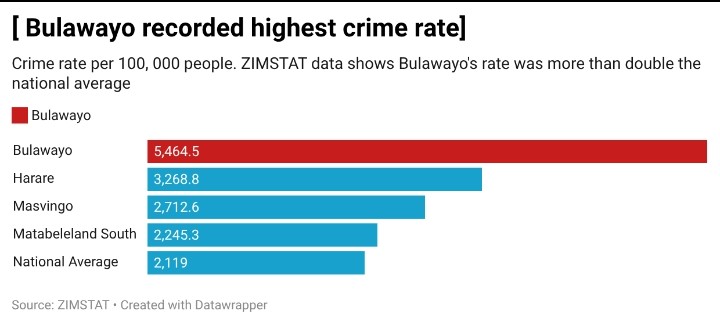
According to the Zimbabwe National Statistics Agency (ZIMSTAT), Bulawayo continues to rank among the country’s most crime-affected provinces.
In its Second Quarter 2025 Crime Statistics Report, ZIMSTAT said: “Vulnerability to crime differs across provinces. In Bulawayo, Harare, Masvingo and Matabeleland South Policing Provinces, crime rates exceeded the national average. Bulawayo recorded the highest vulnerability, with a crime rate of 5,464.5 per 100,000 population—more than double the national average of 2,119.0.”
The agency also reported that “the police recorded 321,640 offences from April to June 2025, a 3.5 percent increase from 310,876 in the first quarter of 2025,” indicating that crime was rising nationally during that period.
Although ZIMSTAT has not yet published provincial crime statistics for 2026, recent incidents reported by police suggest that violent crime remains a significant concern in Bulawayo.
On June 23, police opened a murder investigation after a man was found with stab wounds near the Makaratini turn-off in Old Magwegwe.
Provincial police spokesperson Inspector Nomalanga Msebele has also warned that domestic violence continues to fuel serious crimes. Speaking after recent incidents, she said police were “receiving more reports of spousal violence,” warning that some of the cases were “ending in murder.”
The available data suggests Bulawayo’s crime challenges extend beyond isolated incidents. Residential break-ins, robbery, theft and violence linked to interpersonal and domestic disputes continue to feature prominently in the city’s crime profile.
Crime statistics provide a broader picture than individual cases, helping distinguish long-term trends from short-term spikes in public attention. While recent murders and violent assaults have heightened public anxiety, the official figures indicate that Bulawayo has experienced elevated crime levels over several reporting periods.
For residents, the findings reinforce the importance of securing homes and businesses, remaining vigilant when travelling, and promptly reporting criminal activity to the police.
The evidence points to an enduring challenge rather than a new crime wave. Addressing it will require sustained policing, stronger community partnerships and efforts to tackle the underlying social and economic factors that contribute to crime.